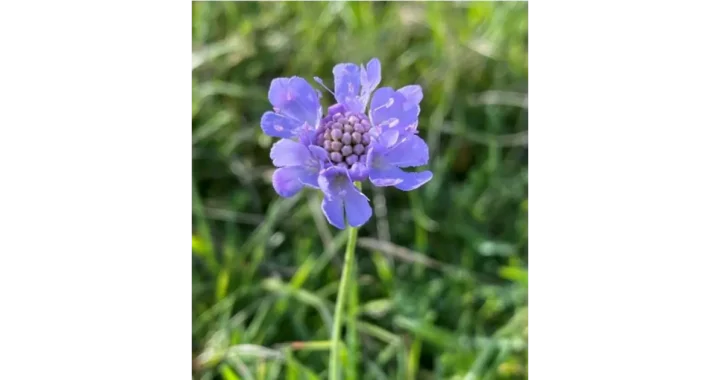
Our precious Chalk Grassland
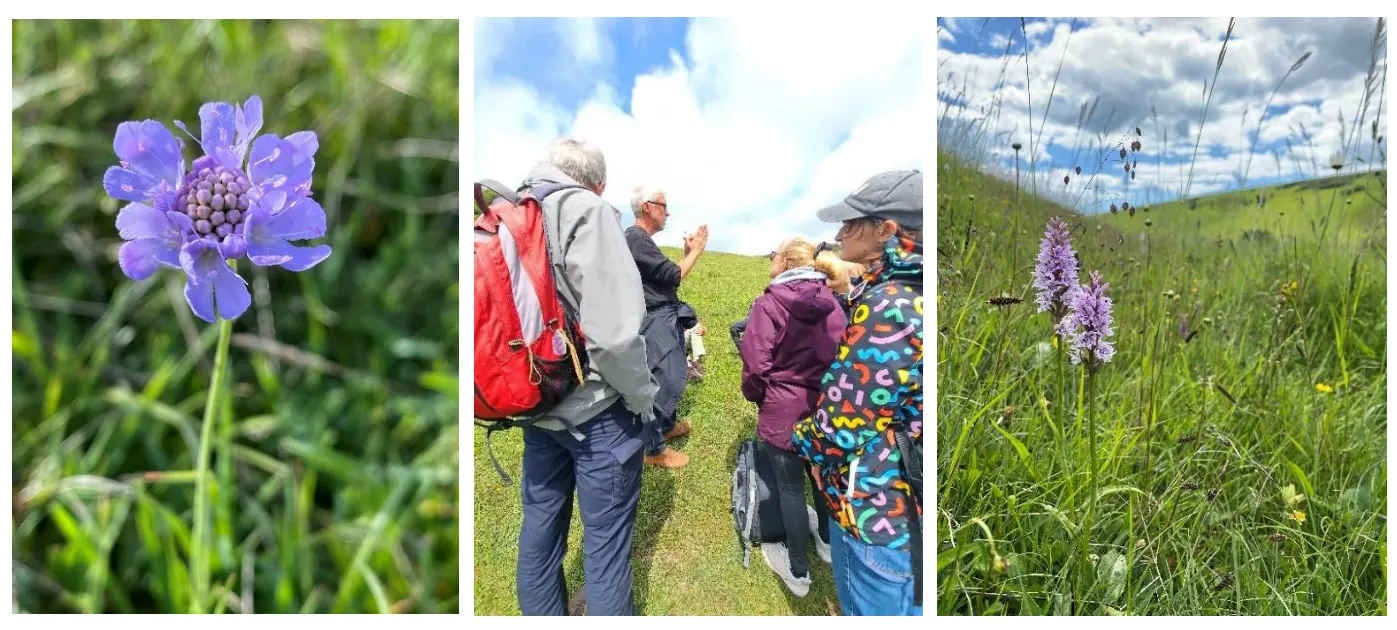
After several days of squally weather, the day dawned dry, though windy and cloudy, as fifteen intrepid flower hunters set out to see what we could find on Castle Hill Nature Reserve just outside Brighton. We were privileged to be joined by Phil Belden, ‘Champion of the South Downs’, who happened to be just walking past “to see what he could find” https://sussexwildlifetrust.org.uk/news/meet-champion-of-the-south-downs-phil-belden.
We set off down the stony path from the car park to the reserve and were immediately detained by some Hedge Bedstraw, Common knapweed and Sainfoin. Richard, our expert botanist and another champion of chalk grassland, explained that Sainfoin was a legume (i.e. a member of the pea and bean family) and had historically been sown as part of crop rotations to fix nitrogen in the soil to improve its fertility. Indeed, over the fence we could see an arable field where plenty of Sainfoin was blooming as part of herbal ley. Continuing along the path we noted some Greater Knapweed and looked closely at some flowering Salad Burnet. Through a hand lens we looked at the tiny red anemone-like female flowers at the centre of its spherical head.
A little further on we walked down the hill towards the reserve proper. Most of us would have ignored the Buttercups as “just buttercups”, but Richard pulled one up (explaining that he only did this when a species was plentiful) to show us the bulbous root. Bulbous Buttercup enjoys drier locations than our other two common buttercups, including on chalk, and grows from bulbs, unlike the creeping buttercup most of us have in our gardens, which spreads with runners.
Nearer the valley bottom (still not yet on the reserve) we stopped to admire the Dropwort spreading up the hillside and had a detailed look at some Cut Leaved Cranesbill and an ant hill. These ant hills are built by yellow meadow ants. The particular conditions that they offer, including frequently replenished loose soil particles deposited by the ants excavating their tunnels and chambers, favour several chalk grassland plants like Wild Thyme. From here we had a good view of the reserve and Richard explained some of its history. Chalk Grassland is our most species rich type of grassland, with many plant species that don’t grow elsewhere. The grassland and its plants also supports a range of special invertebrates like the chalk hill and Adonis blue butterflies, whose larvae only eat one species of plant, horseshoe vetch, which is only found in chalk and limestone grassland. However, it’s estimated that about 70% of the chalk grassland has been lost in the last century and it now covers only 4% of the South Downs. Much was ploughed for conversion to arable or more ‘improved forms of grassland or lost through lack of management and succession to scrub or woodland. Richard pointed out some areas of encroaching scrub. Chalk grassland developed as part of a farmed landscape and grazing, mostly by sheep, is required to keep the scrub under control and prevent the loss of grassland.
A short way further on we entered the reserve and passed through gorse scrub to a classic chalk grassland bank where we found a collection of true chalk grassland specialists including Chalk Fragrant Orchids, a few Common Spotted Orchids. Other species included Birds Foot Trefoil, Kidney Vetch, Fairy Flax, both Lady’s and Hedge Bedstraw, allthree colours (blue, pink and white) of Milkwort, Agrimony, Yellow Rattle, Rough Hawkbit, Restharrow, Small Scabious and Yellowwort.
Tearing ourselves away from the bank we walked past some Silverweed and clumps of Mignonette onto the side of Newmarket Hill. The species we had already seen were plentiful here and we also found some Horseshoe Vetch, which was scattered across the hillside. Sadly, the day was too windy for the blue butterflies to be flying, but Castle Hill is a renowned site for them. Not to forget the grasses we looked at some Quaking Grass, Upright Brome, Meadow Oat Grass, Crested Hair Grass and the low-lying Fescue, all typical in chalk grassland. We talked about the conflicts, in managing Tor Grass, a favourite of Wart Biter Bush Crickets, which perch on it in August, but which can smother the smaller plant species like Early Spider Orchids, another rarity for which Castle Hill is famous. Here Richard pointed out the difference between the abundant Rough Hawkbit and the less frequent lemon-coloured Mouse Eared Hawkweed.
Turning a corner, we decided it was time for some well-earned lunch. Although some of our party needed to head home the rest of us picked our way amongst the Chalk Fragrant Orchids to find a picnic spot. Looking over the valley which had earlier in the year been resplendent with cowslips, we discussed how different parts of the reserve has been subject to different management.
A treat was in store for the stalwarts, however. Turning down a path less travelled, Richard took us to see another speciality of the reserve, Nottingham Catchfly. This member of the campion family and a rare night-scented perennial is designated as Nationally Scarce. It was first discovered on the walls of Nottingham Castle where it is sadly now extinct and can only be found on a small number of sites in the Southeast of England. The flowers are vespertine, meaning they remain closed during the day and open at night to release a clove-like scent. Its sticky stems were once thought to trap flies, but it is actually pollinated by night-flying moths and bats, and it is an essential food for the larvae of the endangered White Spot moth.
Moving on, we started heading home passing the first budding Pyramidal Orchids that any of us had seen this year. Taking a path across the hillside, we were stopped in our tracks by a splendid Round Headed Rampion at its peak. Commonly known as the Pride of Sussex, the Round Headed Rampion is the county flower of Sussex and the reason the Rampion Wind Farm is so called.
Tired but happy, we made our windswept way back to the car park, full of facts and information about species we had seen during the day, which included at least 31 flowers and 7 grasses.